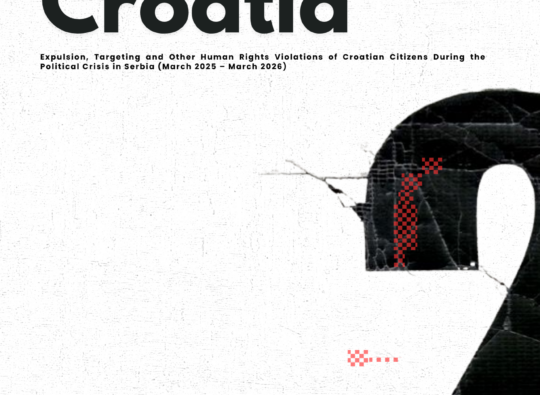
The report continues documenting anti-Croatian propaganda and human rights violations against Croatian citizens, as well as Serbian citizens holding dual Serbian and Croatian citizenship, during the political crisis in Serbia. Particular attention is given to cases in which Croatian nationals had their residence permits revoked on the grounds that they posed an “unacceptable security risk,” as well as to the role of state institutions and the media in creating and sustaining such practices.
The report was presented by Kristina Todorović, lawyer at the Lawyers’ Committee for Human Rights (YUCOM), Zoran Gavrilović, Executive Director of the Bureau for Social Research (BIRODI), and Ivana Nikolić, Research Coordinator at the Youth Initiative for Human Rights and author of the report.
Nikolić presented the report’s main findings, with particular emphasis on the conduct of state institutions and the misuse of the term Ustaša as a tool for targeting political opponents and dissenting voices. She explained that between 11 December 2024 and 1 March 2026, words containing the root “Ustaš-” were mentioned at least 15,488 times in pro-government media outlets in Serbia—approximately one-third more than during the period preceding the outbreak of mass protests in the country.
“It is normal for journalists to report on Ustaša crimes. What is not normal is talking about them every single day. Yet these television stations mention crimes committed by the Independent State of Croatia every day (…) The fact that this is discussed daily only confirms that the aim is to divert attention from the real problems facing this country and to exploit everything that has ever been portrayed as coming from Croatia in order to suggest that Croats cannot be trusted,” Nikolić said.
Zoran Gavrilović pointed out that this rhetoric is aimed at a particular segment of the ruling regime’s electorate in Serbia:
“They do not do this simply because they hate someone, perhaps ideologically. They call people ‘Ustaše’ in order to persecute them through the media, while avoiding discussion about why Serbia is now ranked among the worst countries in terms of corruption, or why it performs so poorly on the rule of law. Instead of talking about reforms, they talk about ‘Ustaše’ and people allegedly organizing some kind of revolution here.”
Gavrilović recalled that BIRODI had submitted a request to the Regulatory Authority for Electronic Media (REM) to examine media content in which citizens are labeled as Ustaše. He expressed hope that the newly appointed REM Council would respond to the promotion of hate speech. Numerous instances of hate speech by public officials directed against the Croatian people continue to go without political or legal consequences. For example, Nemanja Zavišić, Deputy Speaker of the Assembly of Vojvodina, has faced no sanctions despite stating from the parliamentary podium in March this year that “all Croats are Ustaše.”
Addressing the cases involving the expulsion of Croatian citizens, Kristina Todorović explained that the state has discretionary authority to deny foreign nationals entry into or residence in the country. However, every such decision must be properly reasoned and substantiated; otherwise, such actions amount to ethnic stigmatization.
The report is available at the following link.
*The promotion of the publication was carried out with the financial assistance of the European Union. The Youth Initiative for Human Rights is solely responsible for the content of the promotion and the publication, and such content does not in any way reflect the official views of the European Union.