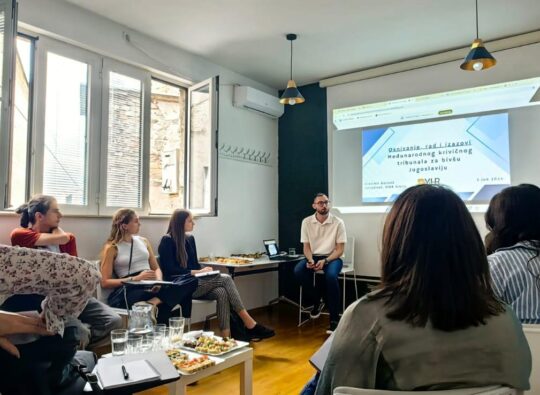
The first day of the workshop started with the introduction of the workshop participants to the organizers, agenda and planned activities. The first lecture, entitled “Conflict and conflict transformation”, was held by Branimir Đurović, a researcher of the Youth Initiative in Serbia, who presented the workshop participants with the basic theoretical assumptions and concepts of the study and analysis of conflict and conflict transformation, after which the focus of the lecture was on the conflict between Serbs and Albanians throughout history and attempts to reconcile the two peoples.
The second day of the workshop began with a visit to the Reporting House, a museum that documents the war in Kosovo and the stormy events of the 1990s through photographs, journalistic stories and contemporary art. Accompanied by the curator, the participants of the workshop had the opportunity to learn about the circumstances that led to the war in Kosovo, as well as about the course of the war itself, but also about the everyday life of people at that time.
After the visit to the museum, Ilir Vitija, program coordinator of the Youth Initiative in Kosovo, gave a lecture on propaganda, its strategies and purpose, especially in the context of the war in Kosovo and the processes that followed. During this lecture, workshop participants had the opportunity to work in small groups to create propaganda posters about the war, with the aim of gaining insight into how propaganda is created and used through practical work.
The third day was dedicated to a visit to the “Children of the War” museum, where the participants of the workshop had the opportunity to learn about what childhood in a war environment looks like through personal items of children who grew up in Kosovo during the war, such as toys, clothes and photographs. After that, Dalia Koler, program coordinator of the Youth Initiative in Serbia, gave a lecture on how art and creative work can be used for the purposes of peace activism.
The last, fourth day of the workshop started with a storytelling workshop held by Dalia Koler, where workshop participants learned about storytelling techniques, which they then used in creating stories and materials about war, peace and their own experiences. After that, Ilir Vitija held a reflective session, during which the workshop participants reflected on the activities they attended, sharing their impressions and comments. At the very end, the participants of the workshop had the opportunity to talk with the young Kosovar activist Erion Krasniqi, who shared his experience of peace activism in Kosovo.
The workshop was organized as part of the Cross Border Youth Dialogue project, which aims to promote reconciliation, cooperation and dialogue between the two communities through bringing together and getting to know young people, in order to encourage the creation of an environment that should facilitate the process of normalizing relations between Serbia and Kosovo. The project is implemented jointly by the Youth Initiative for Human Rights in Serbia and the Youth Initiative for Human Rights in Kosovo.
*The workshop was organized with the financial support of the European Union. Its content does not reflect the views of the European Union, but exclusively of its organizers.