A group of eight young researchers had the opportunity, during the five-day workshop, to acquire fundamental knowledge about the breakup of Yugoslavia, the armed conflicts and war crimes of the 1990s, and the role of the Federal Republic of Yugoslavia (FRY), i.e., Serbia, in these conflicts through judicially established facts from the judgment against Jovica Stanišić and Franko Simatović Frenki. Participants also learned about key concepts of international law and the work of the International Criminal Tribunal for the former Yugoslavia (ICTY), while developing practical skills and tools for independent research.
The workshop opened with a lecture by historian Dragan Popović, who discussed with participants the causes of the breakup of former Yugoslavia and the key events that preceded the outbreak of armed conflicts.
On the second day, Assistant Professor Janja Simentić Popović and Research Associate Goran Sandić from the Faculty of Political Sciences delivered a lecture on the basic concepts and principles of international humanitarian and criminal law. Branimir Đurović, a researcher at the Youth Initiative for Human Rights, then spoke with participants about the establishment, work, and challenges of the ICTY.
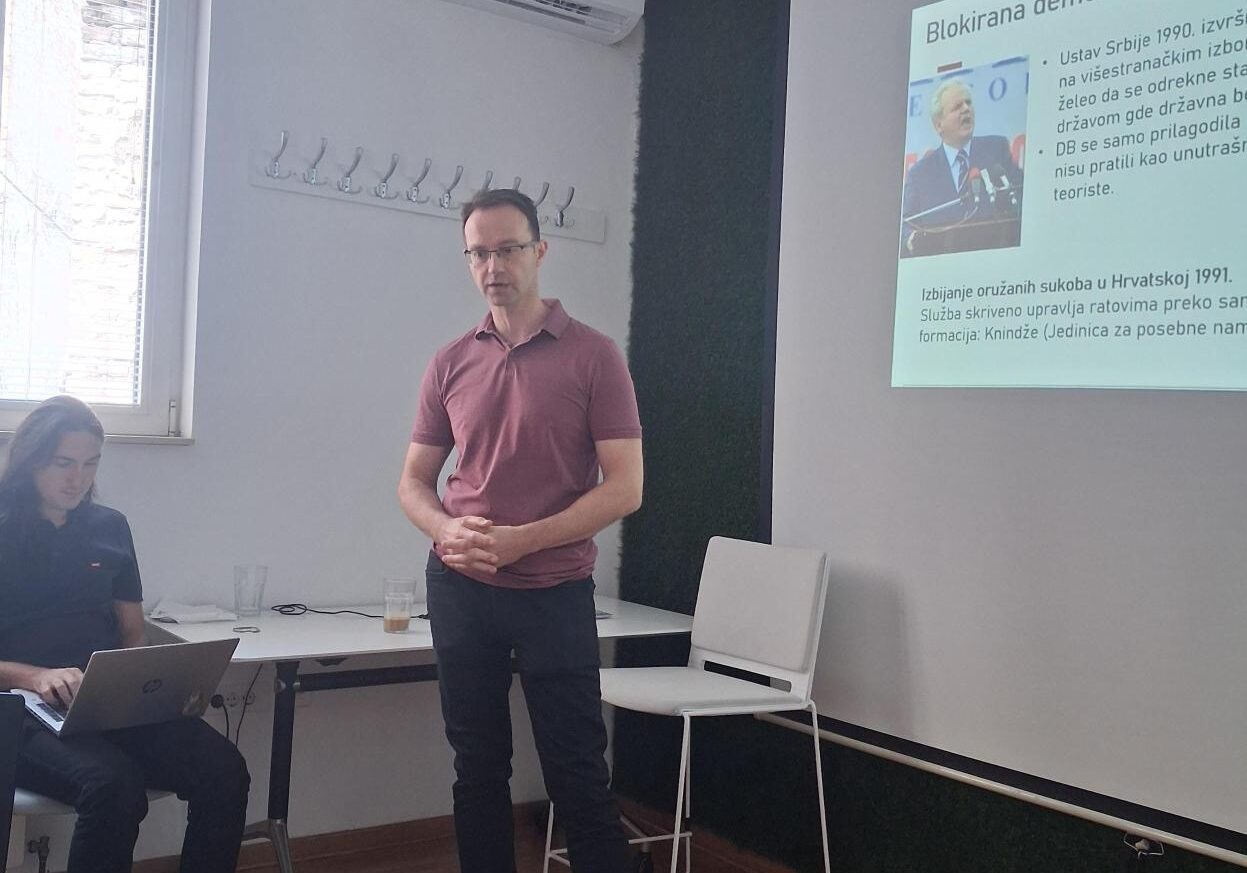
The third day of the workshop focused on Serbia’s security services from the end of the Second World War to the present day. Predrag Petrović, Director of Research at the Belgrade Centre for Security Policy, presented the complex development of these institutions, with particular emphasis on their role during the 1990s, as well as the contemporary context of their activities amid state capture processes and the repressive suppression of mass civic protests.
During the fourth day, Jovana Kolarić, a researcher at the Humanitarian Law Center, presented the role of Jovica Stanišić and Franko Simatović Frenki in the armed conflicts and crimes committed across the territory of the former Yugoslavia. Marko Milosavljević, Head of Research and Advocacy at the Youth Initiative for Human Rights, spoke about Serbian paramilitary formations during the 1990s and their connections with the institutions of the Republic of Serbia.
On the final day of the workshop, Jovana Kolarić conducted a training session on searching and navigating ICTY court records. At the conclusion of the workshop, participants reflected on the information they had received and the knowledge they had gained throughout the program.
As part of the next phase of the “War Past and Facts” program, the eight young researchers will, drawing on the knowledge and skills they have acquired, write research papers with mentoring and editorial support on the role of Serbia in the armed conflicts in the former Yugoslavia. Particular attention will be given to the May 2023 judgment against Stanišić and Simatović before the International Residual Mechanism for Criminal Tribunals.