
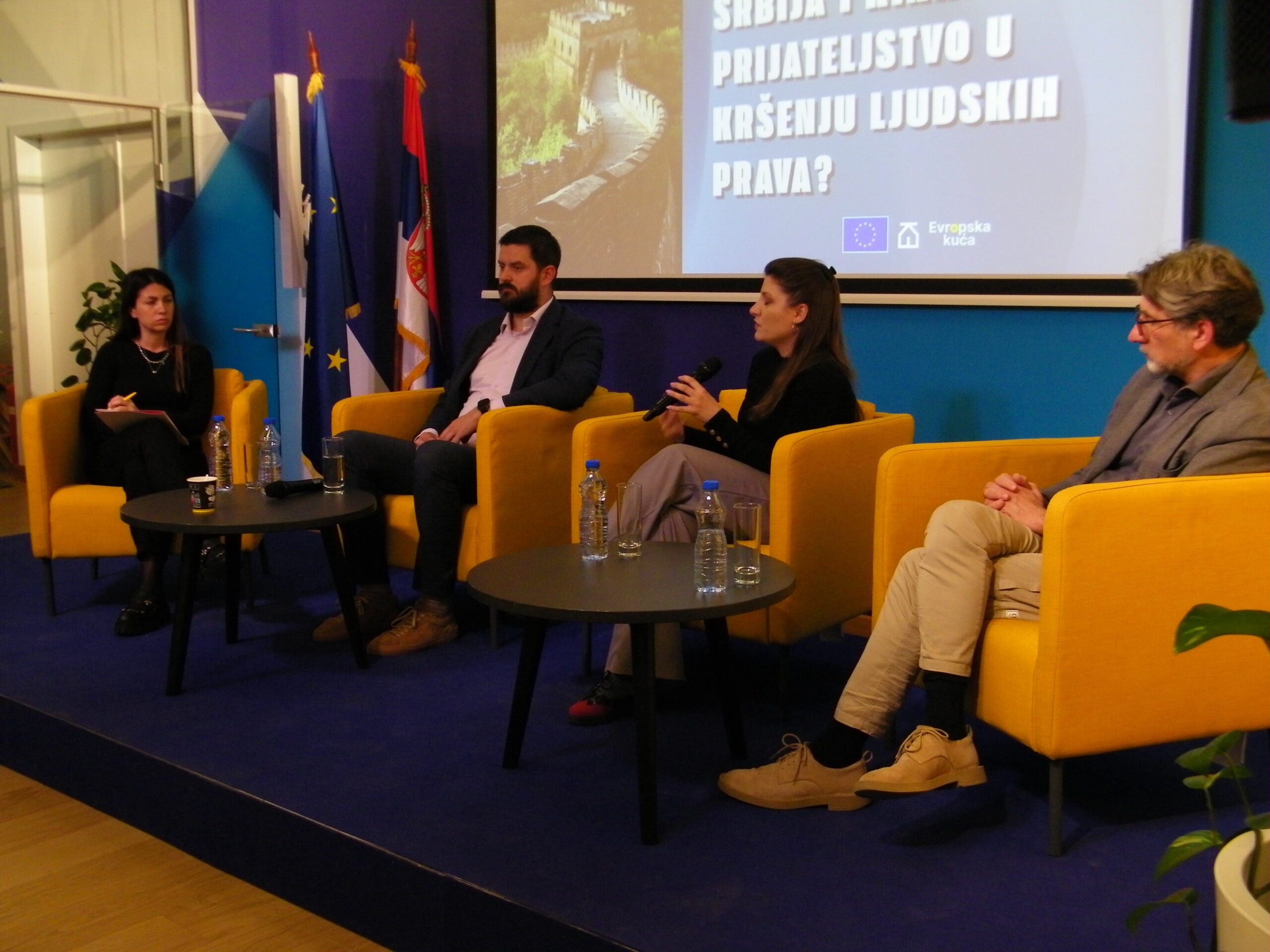
The speakers at the panel were Katarina Pantelić, journalist at Nova Ekonomija; Stefan Vladisavljev, Program Director at the BFPE Foundation; and Dejan Marković, a Falun Gong practitioner and Director of the Serbian-Chinese Friendship Society. The panel was moderated by Ivana Nikolić, Research Coordinator at the Youth Initiative.
Stefan Vladisavljev briefly outlined the history of Serbia–China relations over the past twenty years, noting that the relationship initially relied on economic cooperation and Chinese foreign direct investment, but over time evolved into open support that China provides to Serbia in various areas, including on the issue of Kosovo.
“China’s positioning as a provider of development on a global level is something the Chinese Communist Party deliberately does. It’s not that Vučić or anyone else suddenly wants to promote China – it’s because China seeks to create such a perception of itself globally,” Vladisavljev stated, adding that such a partner is valued by various authoritarian governments, including the one in Serbia.
Katarina Pantelić addressed the operations of numerous Chinese companies in Serbia, noting that China is indeed one of Serbia’s largest economic partners. However, she pointed to numerous shortcomings and irregularities in the work of Chinese companies, particularly regarding violations of workers’ rights and environmental protection regulations.
“This is not about the companies themselves, but about the fact that they are allowed to behave this way. And who allows it? The Serbian state allows them to treat workers and the environment in this manner,” Pantelić explained.
One of the reasons for organizing the panel was a report published by the Youth Initiative in 2025 titled “Serbia vs ‘Falun Gong’: (Un)Friendly Ties of Steel – Unlawful Detention of Falun Gong Practitioners during the Visit of the Chinese President to Serbia in May 2024”.
Dejan Marković presented the history of the Falun Gong group, explaining that it is a form of Chinese meditation, and pointed to the pressure and persecution the group faces from Chinese authorities. He also addressed the position of Falun Gong in Serbia, where, due to the close relations between the two countries, they also face pressure, citing several examples since the Serbian Progressive Party came to power.
“On the day before the Chinese president’s arrival, the Criminal Police Directorate preemptively detained eight Falun Gong activists, and all of them ended up spending the night in police stations in Belgrade. There were no charges, not even questioning. We were held until the Chinese president left, and after that we were released with an apology from the police,” Marković explained, referring to the case from May 2024.
At the very end, all panel participants reflected on the future of Serbia–China relations. Stefan Vladisavljev and Katarina Pantelić agreed that China will remain one of the most important trading partners for a long time, and that Serbia, regardless of the government, will continue to take loans and repay Chinese credits. However, all participants agreed that Serbia must not allow Chinese companies to operate outside domestic regulations.
“China will be what we as a state allow it to be,” Vladisavljev concluded, while Marković added: “The rule of law is the solution to everything.”