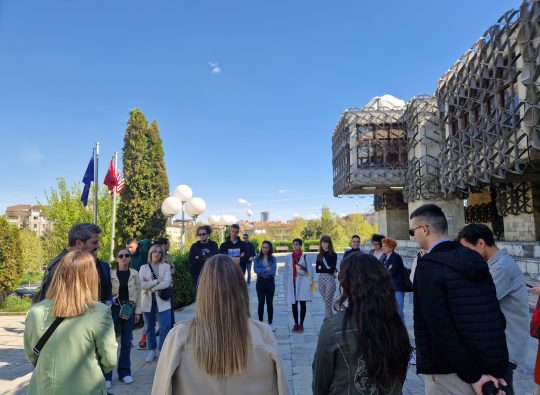
The visit was organized by the international NGO “Conciliation Resources”, which has been working on peacebuilding in post-conflict societies for over 30 years — from the Pacific to Africa and Southeast Asia. The young activists, engaged in human rights and peacebuilding efforts in their own region, showed particular interest in topics such as missing persons, attacks on civil society, bilateral relations among former Yugoslav countries, and examples of cross-border collaboration between artists and journalists in the Western Balkans. They were welcomed by Marko Milosavljević, Head of Research and Advocacy at the YIHR office in Belgrade, who spoke with them about the organization’s work, the current political crisis in the country, and the ongoing mass protests. The group was especially interested in the “Mirëdita, dobar dan!” festival.
The conflict in the South Caucasus began in 1988, escalating into full-scale war two years later. A ceasefire was signed in 1994, bringing a fragile peace that lasted two decades. That truce was broken in 2016, and in 2020, another war erupted, lasting 44 days.
According to data by the International Commission on Missing Persons (ICMP), nearly 5,000 people have been reported missing since the beginning of the Armenian-Azerbaijani conflict. On September 19, 2023, Azerbaijan launched a military offensive that brought an end to more than 30 years of de facto self-governance by the Armenian population in Nagorno-Karabakh, triggering a mass exodus from the region.