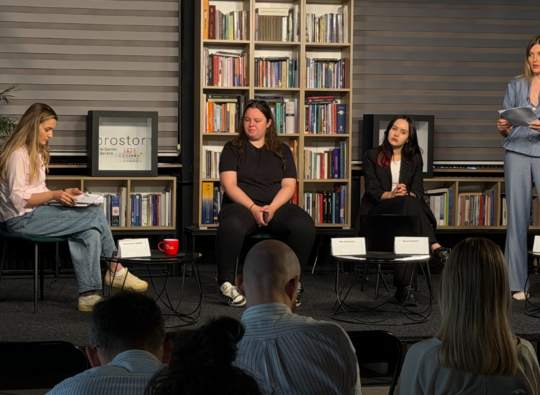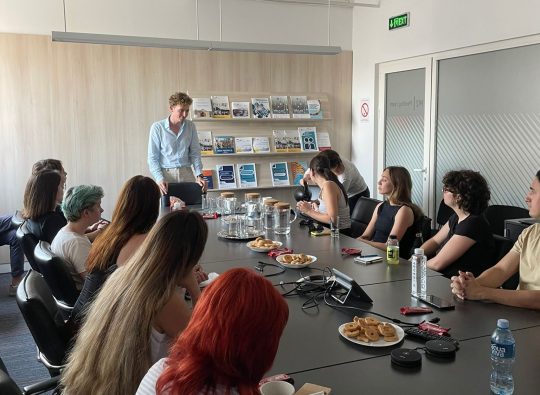
During their week-long stay, young people from Albania, North Macedonia, and Serbia had the opportunity to meet with representatives of civil society organizations and institutions. The visit began on Monday, April 20, with a meeting with representatives of the SHARE Foundation, where participants learned about the organization’s work, innovations and challenges in the digital sphere, as well as the challenges faced by activists and journalists in Serbia in the context of the use of spyware by security agencies.
On Tuesday, April 21, participants visited the Open Society Foundation Western Balkans, where they learned more about the organization’s history, its work, and the challenges it has faced over decades of activity in Serbia and the region. The meeting also covered Serbia’s EU integration process, the current socio-political crisis in the country, and the future of the region. Later that day, a meeting was held with the National Youth Council of Serbia (KOMS), where discussions focused on the positions and needs of young people in Serbia, youth participation in activism and politics, and the impact of student protests on young people.
Wednesday, April 22, was dedicated to a so-called “memory walk,” during which the research team of the Youth Initiative for Human Rights guided participants through central Belgrade, introducing them to the recent history of the city, Serbia, and the wider region. Participants visited the damaged part of the Radio Television of Serbia building in Aberdareva Street, which was hit during the NATO bombing, monuments dedicated to victims of the 1990s wars in Tašmajdan Park, as well as the remains of the former General Staff building on Kneza Miloša Street.

On Thursday, April 23, the program continued with a lecture at the Faculty of Political Sciences, where participants had the opportunity to learn from professors about the role of universities and the academic community in student protests, pressures on higher education, the structure and functioning of the student movement, and upcoming elections in Serbia. This was followed by a meeting at the Palace of Serbia with representatives of the Ministry for Reconciliation, Regional Cooperation and Social Stability, where discussions focused on the establishment and work of the ministry, its results and achievements so far, as well as the challenges and obstacles it faces.
Friday, April 24, was dedicated to group reflection on the topics covered during the week. Participants also had the opportunity to work together on their research and policy proposals, in cooperation with program alumni and staff of the Youth Initiative for Human Rights.
The Regional Youth Leadership Mobility Programme (RYLMP) is implemented jointly by the Youth Initiative for Human Rights (YIHR) from Serbia, the Youth Educational Forum (YEF) from North Macedonia, and the Center for Science and Innovation for Development (SCiDEV) from Albania. The program brings together 20 young activists and researchers from the region who collaboratively work on policy proposals in the fields of regional cooperation, digital and green transition, education and employment, youth participation, and migration. The program is funded by the Open Society Foundation Western Balkans.