The Drina Summer School began with an introduction to the participants, their motivations for participation, and a presentation of the program. The second day of the summer school was opened by historian Dragan Popović with a lecture on the political context before the war and the breakup of Yugoslavia, while Marko Milosavljević, head of research and advocacy at the YIHR, presented the course of the war chronologically. Dalia Koler, YIHR program coordinator, spoke about sexual violence in the war, with reference to the events in eastern Bosnia and Herzegovina.
On the third day of the summer school, assistant professor Janja Simentić Popović and research associate Goran Sandić, from the Faculty of Political Sciences of the University of Belgrade, held two lectures on international humanitarian law and relevant international legal terms and concepts important for understanding the war and crimes committed in Bosnia and Herzegovina, as well as on the judgments of the International Criminal Tribunal for the former Yugoslavia. Marko Milosavljević introduced the participants of the summer school to the role of Serbia in the war in Bosnia and Herzegovina, while Dragan Popović spoke about the genocide in Srebrenica, its preparation and course.
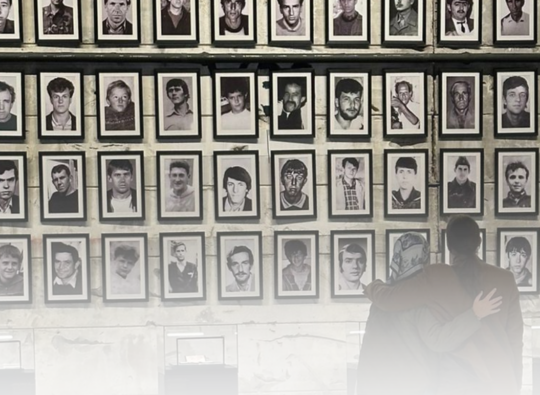
The fourth day was dedicated to visiting the Memorial Center in Srebrenica and the Museum of Genocide. During this visit, participants had the opportunity to learn from the curator details about the genocide itself, with an insight into the daily life of people in Srebrenica during the war, as well as about the search for mass graves and the remains of the victims. At the end, the students of the school visited the cemeteries where they paid their respects to the victims of the genocide. After returning from the memorial center, the organizers of the Drina Summer School held a reflection where the participants shared their impressions and emotions about this visit and the knowledge they gained.
On the fifth day of the Drina Summer School, a tour was organized to the former camp for Bosniaks in the village of Šljivovica, in the municipality of Čajetina. At the very location where the camp used to be, Jovana Kolarić, researcher of the Humanitarian Law Centre, held a lecture on deportations and camps for Bosniaks. The lecture was also attended by Ružica Marjanović, a professor of literature and activist from Užice, who told when and how she found out about the camp in Šljivovica and how she tried to spread awareness about the existence of such a place of suffering.
The last day of the Drina Summer School was reserved for a lecture on the state structure of Bosnia and Herzegovina after the war, which was held by Branimir Đurović, a researcher at the Youth Initiative, with the aim of making participants aware of the consequences of the war in Bosnia and Herzegovina, which are still strongly felt today. At the very end of the program, Dalia Koler and Branimir Đurović, coordinators of the Drina Summer School, led a discussion with participants about the culture of remembrance and peace activism, during which experiences and ideas about these topics were exchanged.
*This event was organized with the financial assistance of the European Union. The Youth Initiative for Human Rights is solely responsible for the content of the event, and this content in no way expresses the official views of the European Union.